


BRPLDCR · subsidyBooking open
Jeevan Park, Uttam Nagar
Rooftop plant · Open
- Whole plant
- 50 kW
- Price
- ₹50,000 a kW
- Upkeep
- ₹200 a kW a month
- Guaranteed
- 1,200 units a kW a year
31% reserved34.5 kW left · 63 panels
10% booking amount
Y2 Solar
Loading page
No roof of your own? Buy solar panels on a rooftop we build elsewhere in Delhi. What they generate comes off your own bill every month, for ten years. The panels are yours; the work is ours.
Chhat nahi? Koi baat nahi. Apna solar share book karo, bill ghatao.
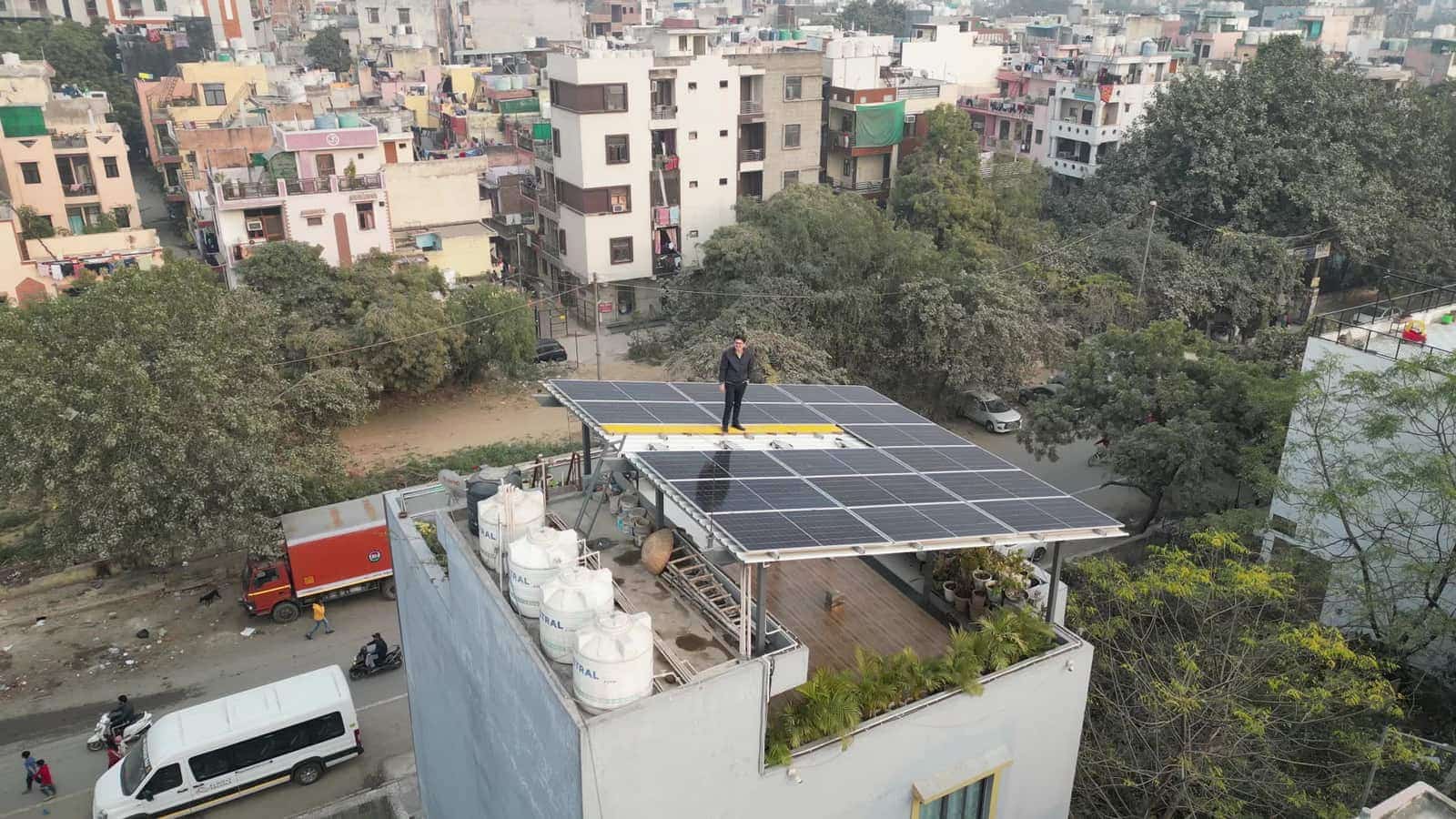
A Y2 Solar rooftop plant in West Delhi, filmed from the air.
A Delhi home usually buys 3 to 3.5 kilowatts.
About ₹50,000 a kilowatt before subsidy. A Delhi family usually needs 3 to 3.5 kW. They stay your property for ten years, and we buy them back at a published price whenever you want out.
A society terrace, a warehouse, a factory shed in your part of Delhi. We build, clean, repair, insure and monitor. You never go there.
Your share of what the plant makes is subtracted from your bill at your own tariff, every cycle, for ten years. A 3.5 kW share takes most of a ₹4,000 bill away.
A unit. One kilowatt-hour. It is the thing your electricity bill counts, and what a solar panel produces.
Your DISCOM. Your electricity company. In Delhi that is BSES Rajdhani, BSES Yamuna or Tata Power, depending on where you live. Your bill says which.
Not an investment scheme. You are buying equipment that cuts your own bill, nothing more.
Your electricity company works out your share of what the plant generated and takes those units off the bill, at the tariff you would have paid for them. Nothing else about your connection changes.
Do it with your own billA home with a ₹4,000 bill, about 542 units, and a 3.5kW share, on Delhi's current slabs with fixed charges, surcharges and tax included, exactly as the calculator below works it out. Delhi's 200/400-unit bill subsidy does not apply above 400 units, and under the 2026 rules not at all once a home has a solar share.
You are asked for a bill, a name and one payment. The rest is our job.
We turn your bill into units, then work out how many panels would wipe out most of it. We never sell you more than you use.
You will only see plants served by your own electricity company, because that is what the rule allows. Pick one and reserve the panels you need.
Sign the agreement online and pay 10% to hold your panels. We build the plant and file your credit and subsidy applications with the electricity company.
The plant has its own meter. Each billing cycle, your share of what it made is taken off your bill. If a year falls short of 1,200 units per kW, we pay you the difference.
Delhi has millions of roofs. Most of them are shared, shaded, rented or already full.
That is the only reason this product exists. Your panels go on a roof that works, and the electricity finds you instead.
If you own a clear roof and plan to stay put, put solar on it. This is for everyone else.
| Rooftop solar | Y2 Community Solar | |
|---|---|---|
| Roof needed | Your own, unshaded, structurally sound | None. The plant sits on a roof we rent nearby |
| Cleaning & maintenance | Yours: cleaning every fortnight, inverter service, insurance | Y2 does all of it for the full 10 years, covered by the monthly fee |
| Generation guarantee | None. A bad year is your loss | 1,200 units per kW per year, shortfall paid at ₹6 a unit |
| If you move house | The system stays on the old roof | Your share moves with you, anywhere the same electricity company supplies, for a ₹2,500 re-mapping charge |
| If you want out | Second-hand panels have little resale value | On any anniversary of commissioning, with 3 months' notice, Y2 buys back at 10% a year straight-line depreciation on what you paid, less ₹5,000 per kW |
| PM Surya Ghar subsidy | Yes, with Indian-made panels | Yes, on our subsidy projects |
| Bill credits | Credited on your bill at your own tariff | Credited on your bill at your own tariff, every billing cycle |
| Ownership | Yours | Yours. The panels, inverter and share stay your property for the full 10 years |
| After 10 years | Panels are yours for 25 years | Renew at half the capacity fee, or take your panels away. Six months’ notice either way |
Put in your bill and see what is left after the solar credits. Change anything and the numbers move with you.
≈ 542 units a month at BRPL rates
Printed on your bill. It only affects the fixed charge, which solar does not change.
Recommended: 4.5 kW, the largest size that stays within what you use, covering about 97% of your units. At 4.5 kW you are billed for about 17 units. Final size rounds to whole panels.
₹50,000/kW · Indian-made panels · PM Surya Ghar + Delhi subsidy for households*
Lower this to see the guarantee kick in.
| Your bill today542 units, incl. surcharge and tax, above Delhi's 400-unit subsidy limit | ₹4,002 |
| Bill after solar credits525 units credited; 17 units billed | ₹254 |
| Saving on the bill | − ₹3,748 |
| Service fee (rent + O&M)rises 5% a year | + ₹900 |
| Net in your pocket, per month, year 1 | ₹2,848 |
Floor for 4.5 kW at 98% grid availability. Expected generation is 6,300 units, so no shortfall is due. If a year comes in under the floor, Y2 pays the gap at ₹6/unit.
10% a year straight-line depreciation on the ₹69,000 you paid net of subsidy. Subsidised shares become eligible for buy-back once the PM Surya Ghar lock-in has passed. You can also transfer your share to another consumer in the same DISCOM.
* Subsidy eligibility, amount and timing depend on the prevailing government rules, regulations and their interpretation by the sanctioning authorities. Figures assume PM Surya Ghar (₹30,000 per kW up to ₹78,000) plus the Delhi state subsidy (₹26,000 per kW up to ₹78,000) notified in 2026, paid by the government directly to a household after commissioning.
Behind the numbers: 1400 units/kW/year expected in Delhi with 0.5% annual degradation; guarantee of 1,200 units/kW/year × 98% grid availability, shortfall paid at ₹6/unit at year end; surplus units paid at ₹5/unit at year end; DERC slabs and fixed charges, BRPL PPAC 35.83%, 8% surcharge, 7% pension surcharge, 5% electricity tax; Delhi's 200/400-unit bill subsidy counted in today's bill where it applies, and not at all once the home has a solar share, as the 2026 gazette provides; tariff rising 3% a year; fee ₹200/kW/month rising 5% a year; one-time processing fee ₹2,000/kW for metering, lease deed registration and documentation; subsidy received in month 3; 10-year term. Estimates only, not an offer.
Pick your electricity company: your credits can only come from a plant it serves. A plant closes when its last panel is taken.
We are launching in BRPL first and will open BYPL projects after completing the pilot. Leave your details on the contact page and we will tell you the day the first BYPL project opens.
We are launching in BRPL first and will open TPDDL projects after completing the pilot. Leave your details on the contact page and we will tell you the day the first TPDDL project opens.
Every subscriber sees only their own share. A monthly statement of units credited and rupees saved goes out on WhatsApp from the first bill.
From commissioning day you get a login that shows what your share is generating right now, what it made this month, and every day of the month behind it. The same feed decides the generation guarantee, so there is nothing to take on trust.
Industrial sheds, society terraces and commercial rooftops in South and West Delhi earn ₹15 to ₹18 per square yard every month for ten years, rising 5% a year. Y2 Solar builds and runs the plant. You spend nothing.
You never pay for something that does not exist yet.
Pick a plant and a size, tell us your name and a number, pay 10% plus the processing fee.
Booking ID, receipt and your agreement to sign, by email and WhatsApp.
Photos on WhatsApp as it goes up. The 80% request comes with the installation report and a 7-day window.
Plant energised and approved. You pay the last 10% and get a login showing your own generation.
From the next bill onward, with a monthly WhatsApp statement of units credited and rupees saved.
Tell us your locality and your bill, and we will tell you which plants serve your DISCOM, what share size makes sense and what it would do to your bill. If community solar is not right for you, we will say so.
Call or WhatsApp us directly. We answer between 9am and 8pm, all week.
+91 80471 36984For a rooftop system on your own roof instead, use the rooftop solar calculator.
Four pages each: how it works, a worked example with the full arithmetic, the open plants and the terms in plain words. Print them or forward them on WhatsApp.
Yes. Delhi's electricity regulator notified the rule in January 2026, and it applies to every consumer in the city. It is called virtual net metering: the electricity company takes the output of a solar plant at one address and credits it against the bill at another, as long as both are served by the same company. Delhi's own solar policy names community solar as one of the ways to go solar. Y2 Solar has three of these plants already running in West Delhi.
No. You are buying solar panels that cut your own electricity bill. Nobody pays you anything: the benefit arrives as a smaller bill, not as income. We never quote a return, a yield or a profit, and you should be wary of anyone in this business who does.
The plant has its own electricity meter. At the end of each billing cycle your electricity company looks at how much the plant made, works out your share of it, and takes that many units off your bill. You will see it as a credit line on the bill itself. The rule that allows this is called virtual net metering, and Delhi opened it to every consumer in January 2026.
We promise each kilowatt of your share will make at least 1,200 units in a year. If the grid itself was down part of the year, the promise is reduced by the same proportion, because a plant cannot export when the grid is off. If the year still falls short, we pay you ₹6 for every unit missing. In a normal Delhi year a kilowatt makes about 1,400 units, so the promise has room in it.
Extra units are stored in your account and used up in the months you consume more. Anything still unused at the end of the year is paid out by your electricity company at about ₹5 a unit, which is less than the ₹8 to ₹11 you would otherwise pay for them. That is why we size your share to your own usage instead of selling you more.
If your new connection is in the same DISCOM area, we re-map your share to the new meter for a ₹2,500 charge. If not, you can transfer it to another consumer in that DISCOM for ₹5,000 per kW, or sell it back to Y2 on the next anniversary at 10% a year straight-line depreciation on the amount you paid net of subsidy, less the exit charge.
Yes, on any anniversary of commissioning, with three months' notice. We buy it back at what you paid, minus any subsidy you received, minus 10% for each completed year, minus an exit charge of ₹5,000 per kW. So ₹72,000 paid net of subsidy is worth ₹50,400 after two years, less the exit charge. Shares that carried a government subsidy can be sold back only after the subsidy's lock-in period. You can also transfer your share to another consumer in the same DISCOM area at any time for ₹5,000 per kW.
One charge, once. A processing fee of ₹2,000 per kW is collected with the booking amount and covers the generation meter and its installation, the stamping and registration of the lease deed for the host roof, and the DISCOM and subsidy paperwork filed in your name. On a 3.5 kW share that is ₹5,250. After that the only recurring charge is the ₹200 per kW monthly fee.
You do. The panels are sold to you and stay your property for the full ten years; the commissioning certificate lists their serial numbers. The inverter, structure, cabling and meters belong to Y2 Solar, which hosts, operates and maintains the whole plant for the monthly fee.
We write to you six months before the term ends with your options. If the host renews the roof lease and spares are still supported, Y2 Solar may offer a renewal at the fee stated in that notice. If there is no renewal, you can take your panels away after paying the dismantling charge, capped at ₹2,500 per kW indexed to inflation, or accept a purchase offer from Y2 Solar if one is made.
On our subsidy projects, yes, if you are a household. The central PM Surya Ghar scheme pays ₹30,000 for 1 kW, ₹60,000 for 2 kW and ₹78,000 for 3 kW or more, and the Delhi Government's 2026 notification adds ₹26,000 per kW up to ₹78,000, for virtual net metering as well. Together that is ₹1,56,000 on a 3 kW share, which is more than the ₹1,50,000 the panels cost, paid straight to your bank account after commissioning. Those projects use Indian-made panels, which the schemes require, and we do the paperwork. Subsidy eligibility, amount and timing depend on the prevailing government rules, regulations and their interpretation by the sanctioning authorities; the calculator lets you switch the Delhi subsidy off to see the figures without it.
If Y2 Solar does not commission the plant within 120 days, everything you paid is refunded in full plus ₹500 per kW as compensation. You can also cancel within 7 days of signing for a full refund. After that, until your panels are installed, a cancellation is refunded less the costs already spent on your share and ₹2,500 per kW; once your panels are installed the booking amount and processing fee are not refundable.
We do, for all ten years. Cleaning the panels, servicing and replacing the inverter, insuring the plant and watching its output are all covered by the ₹200 per kW monthly fee. You are never asked to arrange or pay for any of it.